"We all live within the same illusion and are, in our own way and in our own time, trying to understand the truth behind it all. Some may not be looking at the moment or even in this particular life, but ultimately we will all wake up from the dream and remember who we really are. Ultimately, we will all become one..."
This question of the origin of the universe has been on my mind more than any other in my life and the pursuit of an answer to this question is the reason I write an existential blog. I truly wish there were more individuals in the world who pondered this great mystery.
In this video philosopher Jim Holt starts his talk by asking the question, "Why does the universe exist?", and everyone laughs. Unfortunately, I think that type of response to some of life's bigger questions is a fairly common thing, as it seems we have all taught ourselves not to think too much about those things. We even convince ourselves in many cases that questions of that nature are ridiculous questions to ask, perhaps to protect ourselves from the fear of knowing or the fear of how that might potentially change the way we live and think about our lives and how we perceive our reality.
In truth though, my whole life I don't think I've ever been able to NOT think about this question because it seems so extremely crucial to our existence, so it's always truly baffled me that anyone could go through an entire lifetime without, at least at some point, contemplating this question as well. I believe it's not only perhaps the most important question we can ask ourselves as living, breathing, members of this fantastical universe, but quite possibly the only real question there is to ask...
"Science will always be baffled by new discoveries of things that were never before thought possible, but only because there are no laws that govern man, only limitations of the self." - Aaron Hutchins
If you had a time machine, would you go back in time to kill Hitler? I've been thinking about this age old question recently and have come to some interesting conclusions.
At first glance the answer seems perhaps quite obvious to many of us. After all, killing Hitler would perhaps have prevented the 11-14 million some people from being murdered in the holocaust & would have perhaps prevented a good majority of the 70 million some deaths of World War II. So, it would seem that to trade one life for the lives of millions is easy enough math for any of us to do. The fact that it's still murder by the mind(s) that pass the judgement, the mouth(s) that agree to give the order, the hand(s) that deal the punishment and the heart(s) of those who raise their fists to the sky to rejoice that justice has been done, shouldn't deter us right? In Western culture it seems that many of us would most likely concur that the act be done. After all, we've been breast fed by Western religion and Judeo-Christian values for hundreds, if not more than two thousand, years; ethics which have brought us such visionary concepts as: "an eye for an eye" must be taken, capital punishment must be upheld, penance must be made to atone for one's sins. Toss him to the lions that he might be judged by God for all eternity! (Our brand of)"Justice" MUST be done.
Conversely, many Eastern philosophies and religions, however, might venture to say quite the opposite. That life is a personal journey of one's own consciousness. That one faces the ultimate judgement for their transgressions in life and beyond from one's own self. That the karmic consequences for our actions and our own revelatory realizations of which...and of our connection to all things in the universe...and of the degree to which we loved those things, might be more severe for the soul of the individual than any punishment that could ever be delivered by man.
Western thinking, on the other hand, seems to teach us to strive for one's own, to right the wrongs of others, to intervene in the destinies of those around us in accordance with our own notions of what should be and how this life should be lived. What if it's not our place however, to make such decisions? Did not even Jesus say, "Let him who has not sin cast the first stone"? Was he not saying that no one among us has the right to pass judgement on another? That it is neither our responsibility or our right to punish the wrongful acts of our fellow men and women? If God created man in his own image and we are all children of God, isn't ending the life of another not much different than ending our own?
It is not my intent to discuss religion here exactly, rather more to present the idea that religion has shaped the beliefs and ideals of the entire world since the dawn of time. It's true that there have been many great teachers and enlightened individuals in the past who have taught us a message love, of peace and unity with all mankind, but religion itself has caused great destruction in the world despite those teachings. It has created a great chasm between the hearts of men that has led us into thousands of wars and to millions upon millions of deaths throughout history. It has brought division to a world that has not yet the eyes to see that the Earth and everything on it is in fact one and the same thing. The earth is a celestial body and every organism on it is a part of that body. We and the Earth are one.
So perhaps, personally, if I were to travel in time, I think I would not use that opportunity to exact vengeance on those who have wronged us in the past, but rather,I would head to the future with a sense of wonder and curiosity and I would seek out true wisdom from the universe with a heart filled with love.
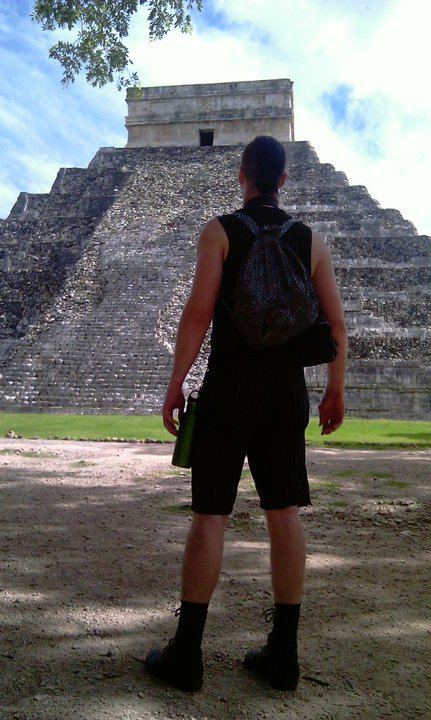
I've been thinking back recently to a trip I took last year to see the Mayan ruins of Mexico and Guatemala. I've always been fascinated with the magic of the region and with Mayan culture, beliefs, architecture, creation myth, etc. This has been particularly true as we near the end of the Mayan long count calendar; an intricate system of time keeping which spans the 5,125 years from August 11, 3114 BC to the winter solstice on December 21, 2012 AD.
Many translations say that the Mayans predicted the end date of the calendar to be the end of a great world age. In fact, it seems the Mayans thought that at the end of this 5,125 year cycle we would enter what they called "The Time of No Time"; a period which would bring with it phenomenal changes and transformation on the earth. These changes, they believed, would propel us into a great evolutionary period on this planet, which would carry our world into a time of new beginnings and deep spiritual growth.
When thinking to myself about all the mind blowing structures that I was privileged enough to experience at each of the ancient sites, I was reminded of just how much of a feeling ofawe and reverence, as well as a deep reflection upon one's own spiritual nature, that each of these spectacular monuments seemed to command. This was a defining experience which planted the seed within me to find more peace and harmony within myself, as well as letting go of fear, that I might one day come to understand more the true nature of existence and reality. Many of these concepts, I feel, have lead me to a place of comprehending, that the road to enlightenment is more than just a quest for personal knowledge. It's about learning compassion and coming back with all that you've learned, with a burning desire to share with other's what following that call within your heart has taught you.
This burning call to action, that all of us experience at one time or another in our lives, got me thinking about the book, "The Hero With A Thousand Faces" by Joseph Campbell. In the book he introduces the concept that all the great journeys in our lives that make epic stories, help us achieve difficult goals and even perhaps lead us down the path of ultimately becoming better people, unwaveringly follow the same progression of events, which he called "The Hero's Journey". Fascinated with this concept, I started researching more about the hero's path, as it no doubt mirrors the path of one whose goal is to seek true inner peace and enlightenment. This can be seen here in this short clip from the fascinating documentary, "Return To The Source: Philosophy And The Matrix", where they briefly discuss Joseph Campbell and "The Hero's Journey", through Neo's path to enlightenment, in "The Matrix" movie.
Now, looking more closely at these steps as a process of spiritual illumination, I began seeing instant parallels with the enlightened figures of the past, such as Jesus or The Buddha, for instance. In both cases, their lives seem to almost precisely mirror this process in perfect sequence. Particularly, the story of The Buddha's life, I think. I've been looking pretty deeply into Buddhism lately and have been completely fascinated with the life of The Buddha, as it is such an inspiring story of giving up everything that feeds "the self" in order to attain a completely pure state of love and compassion for all that is, as well as the obstacles that one must face along the way.
As far as my own "Hero's Journey" is concerned, I have most certainly experienced "The Ordinary World" & I have many times heard "The Call To Adventure", of which I have many times followed. Regarding, the particular call towards deepening my own level of enlightenment, however, I have definitely experienced "Refusal of the Call" more times than I think anyone would care to admit. Perhaps, that phase of the journey though, is by nature, designed to ensnare most any one of us, if only for awhile. I'm not sure I have specifically had my "Meeting With The Mentor" yet, although I have become quite inspired the last few years by the writings, documentaries, talks and teachings of many different spiritual masters and intellectuals advocating the exploration and development of consciousness, compassion and love, as well as refining our ability to perceive who and what we are beyond the veil of the physical world. I've hardly "Crossed the First Threshold" by making some minor changes recently towards helping myself refocus my energy in the direction of this goal. Though, it seems those "minor changes" have already presented me with some rather major "Tests, Allies & Enemies" to be regarded.
So, I am pretty far from my goals in this endeavor. I suppose though, enlightenment, is probably the most trying goal a person can set for themselves in this life, but, then again, I do like to make life difficult. Nonetheless, after many years of deliberation & "refusal", I have embarked on this journey; not quite a "hero" yet, but it's a start and I imagine every hero's story begins somewhere.